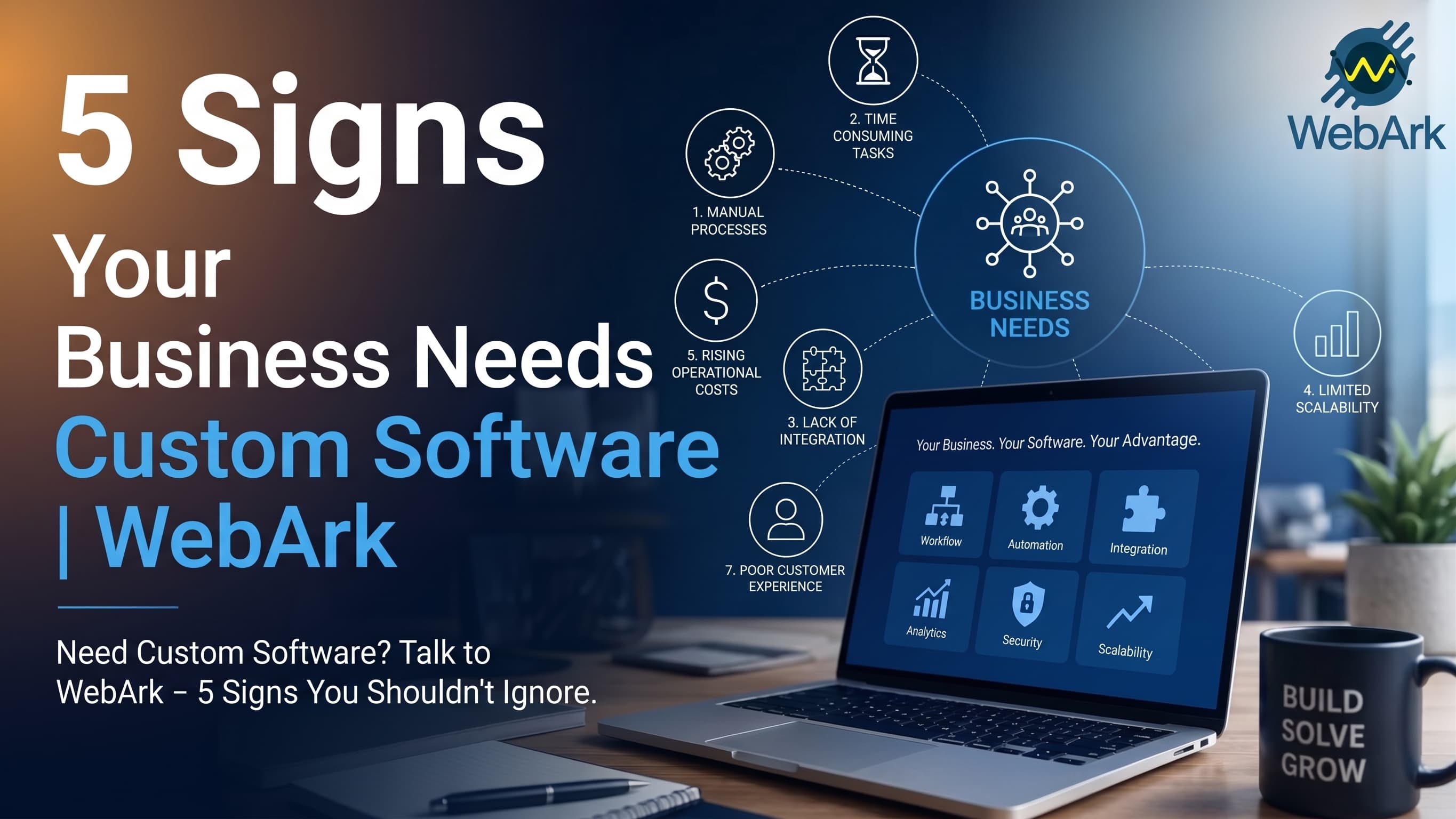
5 Signs Your Business Needs Custom Software
Introduction
Businesses often begin with simple tools.
A spreadsheet manages inventory. Email handles approvals. A few SaaS applications manage customers. A website handles enquiries. Employees communicate through messaging platforms.
At first, everything works.
Then the business grows.
More customers arrive. More employees join. More transactions are processed. More information needs to be shared between departments.
Suddenly, the business is spending hours moving information between systems, fixing spreadsheet errors, preparing reports manually and finding workarounds for software that does not quite fit.
This is often the point where businesses start asking:
“Do we need custom software?”
Custom software is designed around the requirements of a particular organization instead of being created for a broad market. IBM describes custom software development as designing, creating, deploying and maintaining software for a specific set of users, functions or organizations.
Here are five signs your business may be ready for custom software development.
1. Your Business Relies Too Much on Manual Processes
One of the clearest signs is excessive manual work.
Consider a typical process:
Customer enquiry → Email → Spreadsheet → Employee review → Manager approval → Another spreadsheet → Manual report → Customer update
Every step creates an opportunity for:
- Human error
- Duplicate data
- Delays
- Lost information
- Poor visibility
- Unnecessary administrative work
Your employees may be spending valuable time copying information, checking spreadsheets, sending reminder emails or preparing reports that could be automated.
Custom software can automate the workflow
A custom application could transform that process into:
Customer enquiry → Central system → Automated workflow → Approval → Notification → Dashboard
Depending on the business, custom software can automate:
- Customer enquiries
- Order processing
- Approvals
- Employee tasks
- Notifications
- Document generation
- Invoicing
- Reporting
- Data validation
- Status tracking
The goal is not simply to replace spreadsheets.
The goal is to create a more efficient digital business process.
2. Your Software Systems Do Not Communicate With Each Other
Another major warning sign is disconnected software.
Your business may have:
- CRM software
- Accounting software
- Inventory software
- Website
- E-commerce platform
- Employee system
- Mobile application
- Reporting tools
The problem is that these systems may not share information efficiently.
An employee may need to download data from one system and upload it into another.
This creates data duplication and slows down operations.
Example
A customer updates their address.
The sales system has the new address.
The accounting system still has the old address.
The delivery system has another version.
Your employee now has to manually correct information across several applications.
Custom integration can connect the systems
A custom software solution can connect existing platforms through APIs and other integrations.
For example:
Website ↔ CRM ↔ ERP ↔ Accounting ↔ Mobile App ↔ Payment Gateway ↔ Reporting Dashboard
Instead of employees manually transferring information, systems can communicate automatically.
This can improve:
- Data consistency
- Automation
- Reporting
- Customer service
- Operational visibility
- Employee productivity
3. Your Existing Software Does Not Fit the Way Your Business Works
Perhaps you already pay for several software products.
But your team keeps saying:
“The system doesn't support this.”
“We need a workaround.”
“We have to export this to Excel.”
“We cannot integrate that system.”
“This process has to be done manually.”
These are strong signals that your business may have outgrown its current software.
Commercial software is generally built to serve a broad range of customers. Custom software is designed around specific users, functions and organizational requirements.
Instead of changing your business to fit the software
Custom development allows the software to be designed around:
- Your workflow
- Your employees
- Your customers
- Your approval process
- Your business rules
- Your reporting requirements
- Your integrations
This can be particularly valuable for businesses with specialized workflows.
Examples include:
- Logistics
- Manufacturing
- Healthcare
- Tourism
- Real estate
- Financial services
- Education
- Construction
- Retail
- Transportation
- Professional services
4. Your Customers or Employees Need a Better Digital Experience
Sometimes the problem is not your internal process.
It is the experience you provide to customers.
Imagine a customer who needs to:
- Call your company.
- Email documents.
- Wait for an employee.
- Call again for an update.
- Receive a manually prepared status report.
A custom customer portal could allow that customer to:
- Create an account
- Submit requests
- Upload documents
- Make payments
- Track progress
- Receive notifications
- Download documents
- Contact support
This can turn a manual process into a self-service digital experience.
The same applies to employees
A field employee could use a mobile application to:
- View assignments
- Update job status
- Upload photographs
- Capture signatures
- Submit reports
- Record locations
- Receive notifications
- Communicate with the office
Custom software can therefore improve both customer experience and employee experience.
5. Your Business Is Growing Faster Than Your Current Technology
Growth is one of the biggest reasons companies consider custom software.
A process that works for 10 employees may become inefficient with 100.
A spreadsheet that manages 500 transactions may become difficult to maintain when the business processes 50,000.
Growth can create new requirements such as:
- More users
- More transactions
- More integrations
- More reporting
- Better security
- Mobile access
- Role-based permissions
- Multi-location operations
- Multiple currencies
- Multiple languages
- Cloud infrastructure
- Advanced analytics
- Business automation
Your software needs to grow with the business.
A professional development team can design the architecture around current requirements while considering future expansion.
A structured software development lifecycle normally covers activities such as planning, analysis, design, implementation, testing, deployment and maintenance.
Security should also be considered throughout the development lifecycle rather than treated as something added only after development. NIST recommends integrating security practices throughout software development.
Custom Software Does Not Mean Every Business Should Build Everything
Seeing these five signs does not automatically mean your company should build a completely new platform.
Sometimes an existing SaaS product is the right answer.
For example, standard software may be sufficient when:
- Your business requirements are common.
- Existing software already solves your problem.
- You do not require complex customization.
- Your integration requirements are limited.
- The existing workflow fits your organization.
Custom software becomes more attractive when:
- Your processes are unique.
- Existing software requires constant workarounds.
- Multiple systems need integration.
- Manual work is becoming expensive.
- You need a specialized customer experience.
- Your business is scaling.
- Your software is part of your competitive advantage.
The right development partner should help you decide whether you actually need custom software, rather than trying to sell development where a ready-made solution is better.
Why Businesses Consider Remote Software Development
For companies in the USA, UK, France, Australia and other European markets, software development does not necessarily have to be performed entirely by an in-house local team.
Remote and offshore development can provide access to international engineering teams.
One consideration is development cost.
For example, IT Jobs Watch reported a median £495 daily rate for UK remote/hybrid software developer contract vacancies during the six months ending July 31, 2026. Actual rates vary significantly according to role, experience, location and contract structure.
This does not mean an offshore team will automatically be cheaper or better.
It means businesses can compare different delivery models:
- Local development
- Nearshore development
- Offshore development
- Remote development
The right decision should consider cost, quality, communication, technical capability, security and long-term value together.
Why Consider Sri Lanka for Software Development?
Sri Lanka has an established ICT services and export sector.
The Sri Lanka Export Development Board lists capabilities including:
- Software development
- Web development
- Mobile application development
- Cloud services
- ERP software
- Systems integration
- Real-time systems
- Application development
- Quality assurance and testing
- IT consulting
The EDB also describes Sri Lanka as an offshore development location serving international companies from markets including the USA, UK, Ireland, Australasia and European countries.
For an international business, this means Sri Lanka can be one location to consider when evaluating a remote software development partner.
7 Benefits of Working With a Remote Sri Lankan Development Team
1. Potential Cost Efficiency
One reason international companies explore offshore development is the potential to reduce overall development costs.
Sri Lanka's ICT sector is promoted as combining a skilled talent pool with cost-effective operations.
However, the goal should not simply be:
“Find the cheapest developer.”
The better goal is:
“Find the best value for the required quality and budget.”
A very low development price can become expensive if the project suffers from poor architecture, communication problems, delays or ongoing maintenance issues.
2. Access to a Full Development Team
Building an internal software team can require several specialized roles.
A typical project might require:
- Project manager
- Business analyst
- UI/UX designer
- Frontend developer
- Backend developer
- Mobile developer
- QA engineer
- DevOps engineer
- Technical lead
Working with a remote development company can provide access to several of these capabilities without requiring the client to hire each role independently.
3. Flexible Team Scaling
A company may need a small team during the discovery stage and a larger team during development.
A remote partner can provide a more flexible model depending on:
- Project scope
- Product roadmap
- Development phase
- Feature requirements
- Maintenance needs
This can be useful for startups, SMEs and established businesses.
4. Focus on Your Core Business
Your company may understand the business problem better than anyone else.
You should be able to focus on:
- Customers
- Sales
- Operations
- Product strategy
- Marketing
- Business growth
while the development partner handles the technical delivery.
The best arrangement is collaborative rather than simply handing over a specification and waiting for code.
5. Access to Web, Mobile and Software Development Skills
Sri Lanka's ICT sector includes capabilities across software development, web development, mobile development, systems integration, cloud services and application development.
That can make a remote Sri Lankan team suitable for projects such as:
- Custom websites
- Web applications
- SaaS platforms
- Mobile applications
- Business management systems
- Customer portals
- Employee applications
- API integrations
- Enterprise applications
6. Remote Collaboration
Modern software development teams can collaborate using:
- Video meetings
- Project management platforms
- Git repositories
- Cloud environments
- Documentation tools
- Issue tracking
- Automated testing
- CI/CD pipelines
A remote relationship therefore does not have to mean poor communication.
The key is having a defined process.
7. Long-Term Development Partnership
Your software will probably change after the initial launch.
You may need:
- New features
- Security updates
- Bug fixes
- Performance improvements
- New integrations
- Mobile updates
- Cloud infrastructure changes
- Reporting improvements
A development company that stays involved after launch can become a long-term technology partner rather than a one-time coding vendor.
Why Choose WebArk for Remote Software Development?
WebArk works with businesses that want to transform an idea, business process or operational problem into a digital product.
We can help with:
Custom Software Development
Business-specific software designed around your workflows, users and requirements.
Web Application Development
Custom online platforms such as:
- Customer portals
- Admin systems
- Management dashboards
- Booking platforms
- CRM systems
- Inventory systems
- SaaS platforms
- Internal business applications
Mobile Application Development
Applications for:
- Customers
- Employees
- Field teams
- Sales teams
- Delivery teams
- Service businesses
Website Development
Professional business websites with custom functionality, integrations and content management capabilities.
API & System Integration
Connect existing applications and systems so that information can move more efficiently.
Business Automation
Convert repetitive manual workflows into structured digital processes.
Software Modernization
Improve or rebuild existing systems that have become outdated, difficult to maintain or disconnected from modern technology.
How WebArk Can Work With Your Company Remotely
A remote project can follow a structured process.
- Discovery
- We understand your business, users, problems and objectives.
- Requirements
- We define features, workflows, integrations and technical requirements.
- UI/UX Design
- We design the user experience and application interfaces.
- Architecture & Technology Planning
- We determine an appropriate technical architecture based on the project's requirements.
- Development
- The software, website, web application or mobile application is developed.
- Testing
- The solution is tested for functionality, quality, usability and relevant technical requirements.
- Deployment
- The application is released to the appropriate production environment.
- Maintenance & Growth
- The product can continue to evolve with new features, improvements and integrations.
What Are the Benefits of Hiring a Remote Development Team Instead of Building Everything Locally?
The decision should be based on your specific situation, but businesses may consider remote Sri Lankan development because of several potential advantages:
Potential cost efficiency: Development rates can differ substantially between markets.
Access to skilled technical teams: Sri Lanka has an established ICT services sector covering software, web, mobile, cloud and systems integration.
Flexible resource models: You can potentially access a team without building every technical role internally.
International project experience: Sri Lanka's ICT industry already serves international clients and export markets.
Scalable development: Teams can be structured around your product roadmap.
Focus on business: Your internal team can focus on strategy and customers while the remote team handles technical delivery.
But cost alone should never be the deciding factor.
When comparing a local development company with a Sri Lankan remote partner, evaluate:
- Technical skills
- Previous project experience
- Communication
- Project management
- Security practices
- Code ownership
- Intellectual property terms
- Quality assurance
- Documentation
- Support after launch
- Contract and payment terms
Frequently Asked Questions
What are the signs that a business needs custom software?
The five common signs are excessive manual work, disconnected systems, software that does not fit business processes, poor digital experiences and technology that cannot keep up with business growth.
Is custom software better than off-the-shelf software?
Not always. Off-the-shelf software can be the better option when your requirements are standard. Custom software is more suitable when your workflows, integrations or user requirements are unique.
Is custom software expensive?
The cost depends on the size, complexity, technology, integrations, security requirements and development team. The right comparison should consider total business value rather than only the initial development price.
Can I hire a remote software development company from Sri Lanka?
Yes. Sri Lanka has an established ICT services sector covering software development, web development, mobile applications, cloud services, systems integration and other technology services.
Can US companies work with WebArk remotely?
Yes. A remote engagement can be structured using online communication, project management, documentation, source control, regular demonstrations and clearly defined deliverables.
Can UK businesses outsource software development to Sri Lanka?
Yes. UK businesses can evaluate Sri Lankan development companies for websites, web applications, mobile applications, custom software and ongoing development support.
Can European companies work with a Sri Lankan software company?
Yes. European businesses can work with remote Sri Lankan development teams. For projects involving personal data, regulated industries or sensitive information, the relevant contractual, privacy and security requirements should be addressed before development begins.
Can Australian businesses hire a Sri Lankan development team?
Yes. Australian businesses can engage remote Sri Lankan teams for websites, mobile apps, web applications and custom software. Communication processes should account for the time-zone difference.
Ready to Find Out Whether Custom Software Is Right for Your Business?
You do not need to start with a detailed technical specification.
Start with the problem.
Tell WebArk:
- What your business does
- What process is causing problems
- What your employees currently do manually
- What software you already use
- What you want to improve
- Who will use the new system
- Your preferred timeline
We can then discuss whether you need a website, web application, mobile application, custom business software or an integrated digital solution.
Discuss Your Software Project With WebArk
Email: info@webarktec.com
WhatsApp: +94769277890
Contact Form: https://webarktec.com/contact
WebArk — Your software ideas, built to reality.
Suggested Internal Links
Use these links when the corresponding WebArk pages are available:
- Services →
https://webaktec.com/services - Portfolio →
https://webaktec.com/portfolio - What Is Custom Software? →
/blog/what-is-custom-software
